
leadership shapes more than outcomes
Every leader creates an environment.
The way we respond to pressure, navigate relationships, exercise influence, handle conflict, and repair what gets disrupted shapes more than the work we accomplish. It shapes what people experience around us.
Over time, those experiences become patterns. Patterns become norms. And norms become culture.
That is why leadership health cannot be separated from relational health.
If we want healthier teams and healthier cultures, we have to pay attention to the relationships shaping them—and to the leaders shaping those relationships.
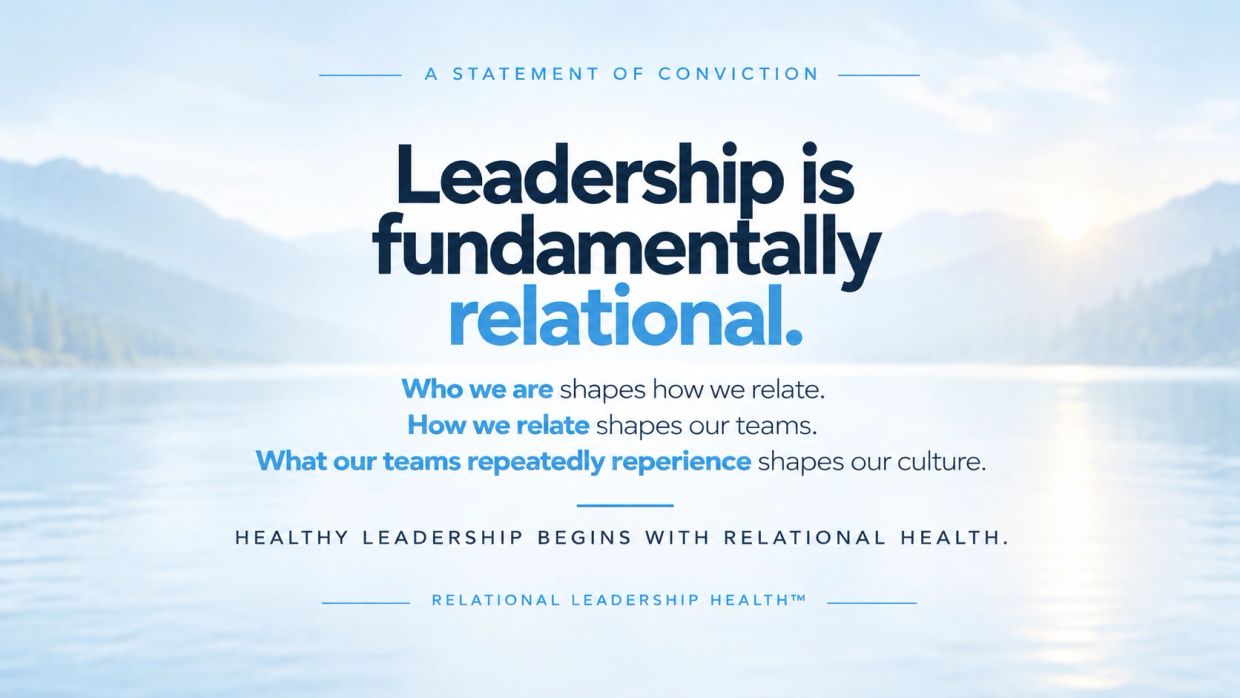
what is relational leadership health?
Relational Leadership Health™ is a framework for understanding how the way we relate shapes the way we lead—and ultimately, the cultures we create.
Leadership never happens in isolation. Every leader brings their story, emotional patterns, relationships, experiences, strengths, vulnerabilities, and ways of responding to pressure into the environments they lead.
The model helps leaders pay attention to four interconnected dimensions of relational health:
WITHIN ME — What is happening within me?
BETWEEN US — What happens between us?
AMONG US — What keeps happening among us?
AROUND US — What keeps happening around us?
Together, these four dimensions help us see leadership as a relational system: what happens within a leader influences relationships; relationships create patterns within teams; and repeated patterns eventually shape culture.
Rooted in clinical science, leadership and organizational health, and spiritual formation, Relational Leadership Health™ provides a practical way to help leaders understand those dynamics—and intentionally cultivate healthier ones.
The goal is not simply better leadership. It is healthier leaders, healthier relationships, healthier teams, and healthier cultures where people and purpose can flourish.
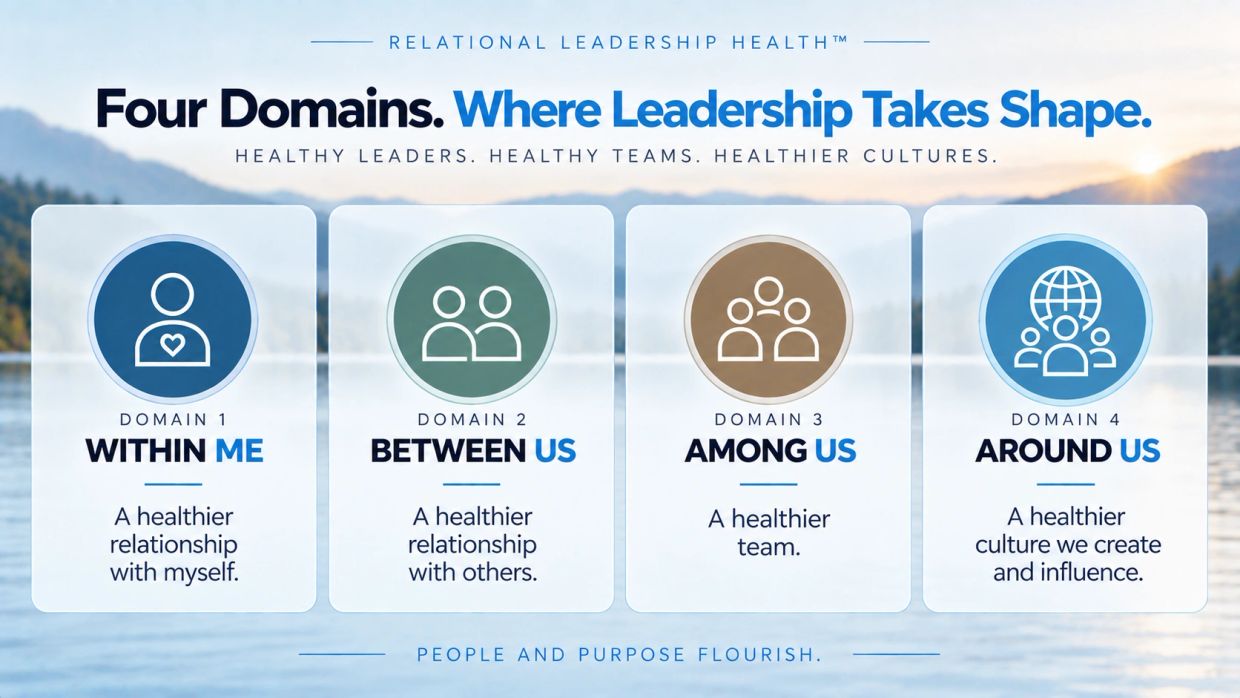
leadership is a relational system
The four dimensions of Relational Leadership Health™ help us see what is often happening beneath the surface of leadership.
What happens within us does not stay within us. It enters the relationships between us. Those relationships develop patterns among us, and when those patterns are repeated over time, they begin to shape the culture around us.
And the influence moves in every direction. Culture shapes teams. Teams influence relationships. Relationships affect leaders. We are continually shaping, and being shaped by, the relational systems we inhabit.
This is why healthy leadership requires more than developing better skills or strategies. It requires the capacity to recognize what is happening within ourselves, understand what is happening between people, notice the patterns forming within our teams, and become intentional about the culture those patterns are creating.
Relational health gives leaders a way to see the whole system—and discover where healthier movement can begin.
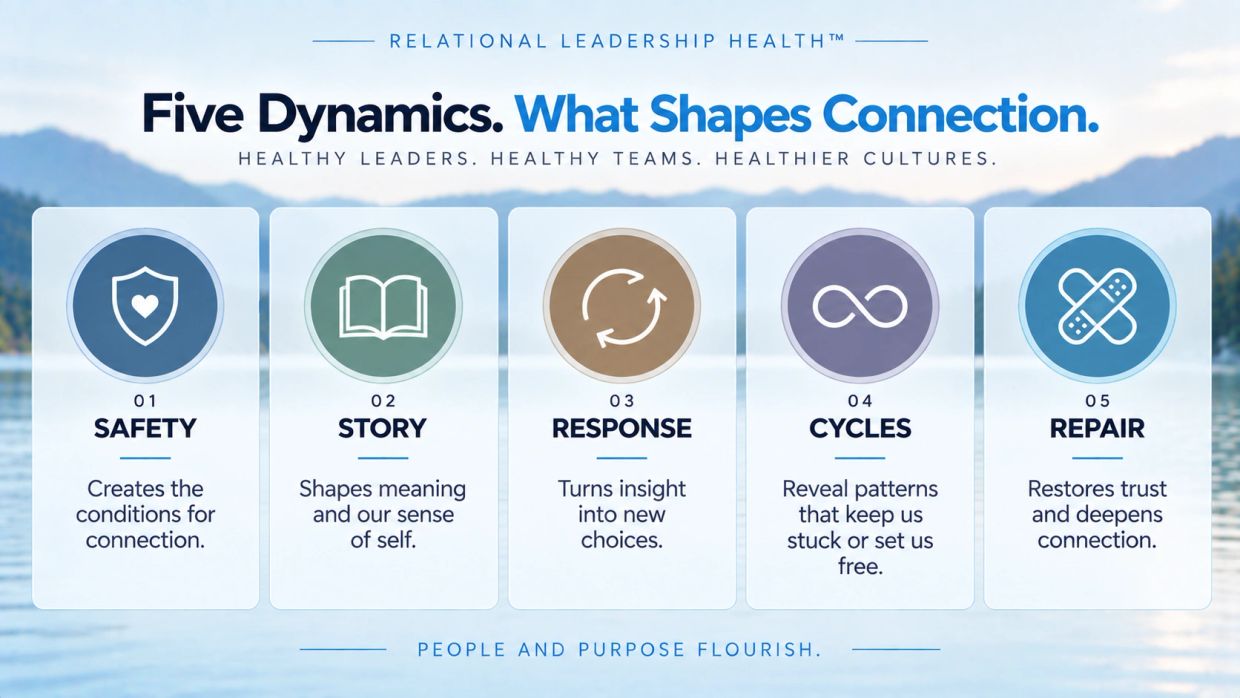
understanding what happens beneath the surface
Across all four domains of Relational Leadership Health™, five dynamics help us understand what is happening beneath the surface of how we lead and relate: Safety, Story, Response, Cycles, and Repair.
Safety. Relational safety is the capacity to remain open, engaged, and connected even when something difficult is happening. Healthy leaders create environments where people can speak honestly, disagree, take risks, receive feedback, and remain connected through challenge.
Story. We bring our experiences, expectations, assumptions, beliefs, and wounds into every relationship. These stories shape how we see ourselves, interpret others, and make sense of what is happening around us.
Response. Under pressure or perceived threat, we naturally move toward protection. As safety and trust grow, we gain greater capacity to move toward connection—with curiosity, honesty, vulnerability, accountability, and presence.
Cycles. Our responses affect one another. Repeated interactions become cycles; cycles become patterns; and patterns can eventually shape team norms and organizational culture. Healthy leaders learn to ask not only “Who is the problem?” but “What pattern are we creating together?”
Repair. Rupture is inevitable. Relational health is reflected in our capacity to name what happened, own our part, restore trust, and create a different experience moving forward.
Together, these dynamics help us see beneath behavior: Safety influences Story. Story shapes Response. Responses create Cycles. Repair creates new possibilities for Connection.
The goal is greater awareness of what is happening, why it is happening, what we are creating together, and how we can respond differently. That is how relational health changes the way we lead.
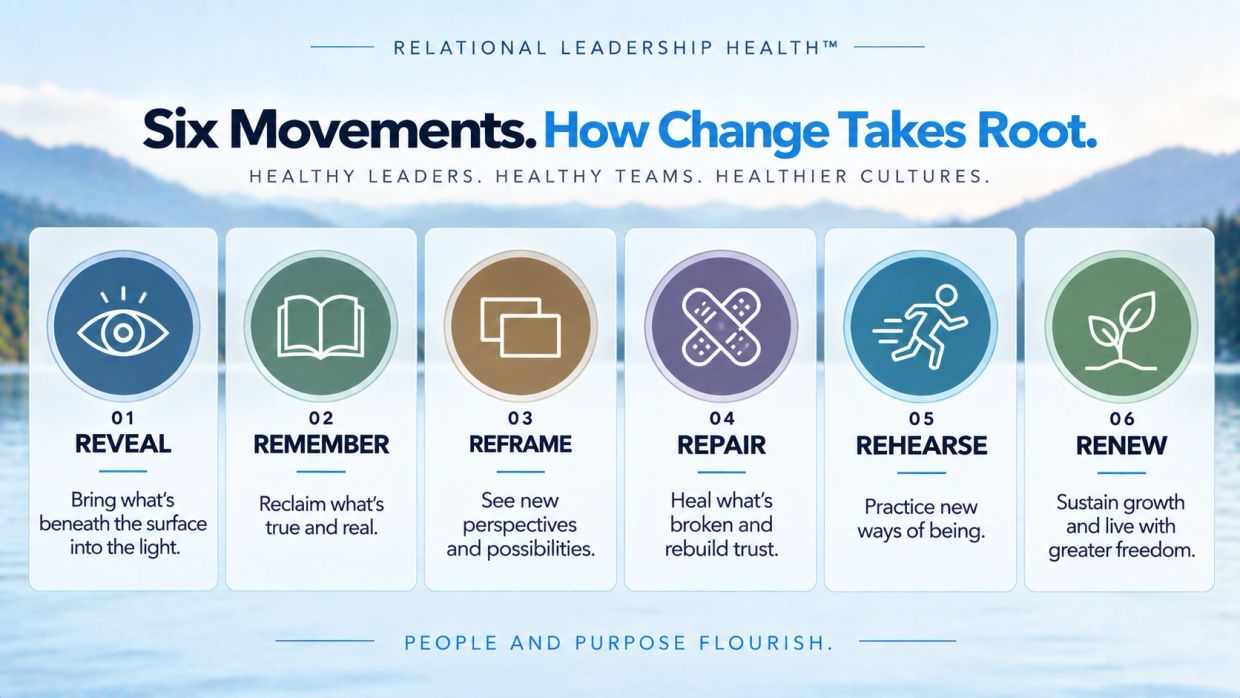
six relational rhythms for healthier movement
Relational Leadership Health™ is informed by Renovi Relational Therapy (RRT), an integrative relational model developed to help people understand the patterns that shape how they experience themselves, others, and their relationships—and create healthier movement toward connection.
Adapted for leadership, six relational rhythms provide a practical pathway for change:
Reveal what is happening.
Remember what may be shaping it.
Reframe how we understand it.
Repair what has been disrupted.
Rehearse healthier ways of relating.
Renew the patterns we want to sustain.
These rhythms are not meant to function as a rigid, linear formula. Leadership and relationships are more dynamic than that. We may move forward, circle back, revisit an earlier rhythm, or work in several at once. The goal is intentional movement toward greater relational health.
Across the four dimensions: Within Me, Between Us, Among Us, and Around Us, these rhythms help leaders move from awareness to action: recognizing what is happening, understanding what is underneath it, taking responsibility for what can change, and practicing healthier ways of leading and relating.
Insight helps us see the pattern. Practice helps us change it. Renewal helps healthier patterns become a way of life.

RELATIONAL LEADERSHIP HEALTH
assess your health
Discover how your leadership is experienced across the Four Domains of Relational Leadership Health™. Gain insight, spot growth opportunities, and take your next step toward healthier leadership.
Reflect. Gain insight. Lead well.